Poetic Trespass by Levy Lital
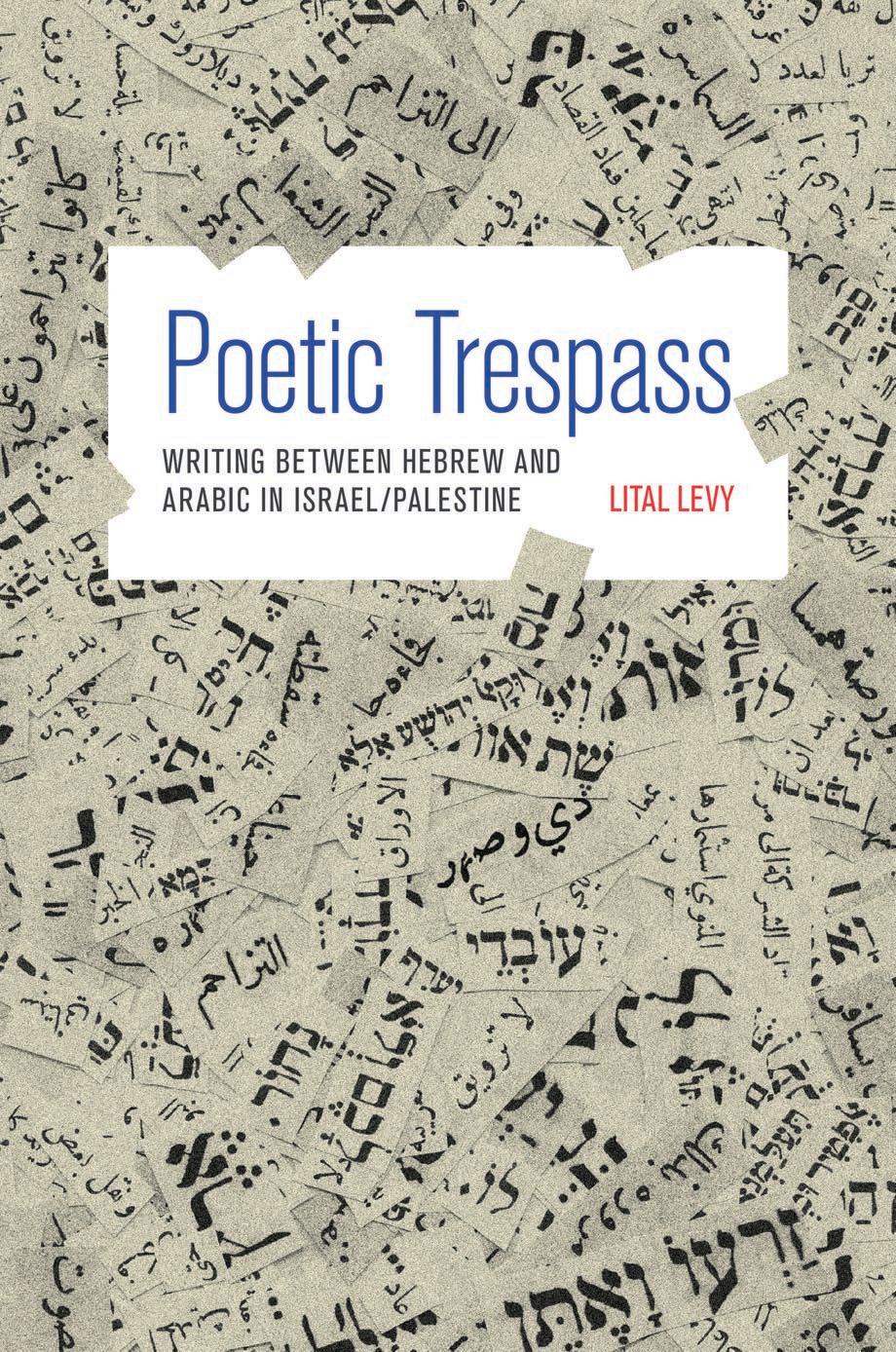
Author:Levy, Lital
Language: eng
Format: epub, pdf
Publisher: Princeton University Press
Published: 2014-07-14T16:00:00+00:00
Part 3
Afterlives of Language
CHAPTER 5
“Along Came the Knife of Hebrew and Cut Us in Two”
Language in Mizraḥi Fiction, 1964–2010
What is it to be authentic, to run through the middle of Tel Aviv’s streets and shout in Moroccan Jewish Arabic: “Ana min-el maghreb, ana min el-maghreb” (I’m from the Atlas Mountains, I’m from the Atlas Mountains).
—EREZ BITTON1
Sometimes I wonder whether this unknown language is not my favorite language. The first of my favorite languages.
—JACQUES DERRIDA2
Why write in a language you don’t know? Or use the one you know to imagine another, “lost” language? Or reinvent your language, perhaps as a secret language no one else understands? In his Monolingualism of the Other, Jacques Derrida provocatively declares, “I only have one language; it is not mine.” That language, his only language, is “the language of the other,” one he sets out to define and redefine in conflicting terms of inhabitation and alienation.3 Derrida traces his paradoxical experience of language and resulting disorder of identity to the anomalous historical situation of Algerian Jews, to whom French citizenship was granted, revoked, and restored. In his telling, Algerian Jews were “interdicted” from Arabic and Berber, from French, and finally (“or to begin with,” he says) from Hebrew. This also cut them off from “Jewish memory,” from the “history and language that one must presume to be their own, but which, at a certain point, no longer was.”4 As an ethnic minority within a colonized nation, Algerian Jews were doubly removed from the homology of language and identity at the core of modern nationalisms. In principle, their experience of language should be diametrically opposed to that of Hebrew-speaking Jews in Israel, who are the ethnic and linguistic majority in their own sovereign nation. How then could Israeli Hebrew be construed by any of its contemporary Jewish speakers as a language “not their own”?
For Mizraḥi Jews in Israel, many of them descendants of Arabic-speaking Jews, Modern (Israeli) Hebrew is no more the language of “Jewish memory” than is French for Derrida. Derrida’s proclamation thus finds an ironic inversion in recent literature by young Mizraḥi writers, for whom his phrase “the history and language that one must presume to be their own, but which, at a certain point, no longer was” encapsulates their feelings about Arabic. Arabic, the language of the recent and almost-tangible Arab Jewish past, is a minefield of contradictions. It is at once intimate and forbidden, known and unknown, remembered and forgotten. It is consciously rejected, even disparaged, by some; nostalgically romanticized and at times “Orientalized” by others. Apart from the dwindling remnant who reached maturity in Arab countries, Jews no longer have access to Arabic in an unmediated, unselfconscious way. To speak it, or to speak of it, is to have a position on it.
As we shall see, however, the Mizraḥi relationship to language is not only a dyadic question of Hebrew versus Arabic, any more than mizraḥiyut (Mizraḥiness) is a simple question of Ashkenazim versus “Sephardim.”5 Mizraḥiyut encompasses highbrow and lowbrow culture, radical and reactionary politics, Arabic and Hebrew (and other languages).
Download
This site does not store any files on its server. We only index and link to content provided by other sites. Please contact the content providers to delete copyright contents if any and email us, we'll remove relevant links or contents immediately.
4 3 2 1: A Novel by Paul Auster(12354)
The handmaid's tale by Margaret Atwood(7727)
Giovanni's Room by James Baldwin(7301)
Asking the Right Questions: A Guide to Critical Thinking by M. Neil Browne & Stuart M. Keeley(5741)
Big Magic: Creative Living Beyond Fear by Elizabeth Gilbert(5725)
Ego Is the Enemy by Ryan Holiday(5392)
The Body: A Guide for Occupants by Bill Bryson(5065)
On Writing A Memoir of the Craft by Stephen King(4919)
Ken Follett - World without end by Ken Follett(4705)
Adulting by Kelly Williams Brown(4552)
Bluets by Maggie Nelson(4534)
Eat That Frog! by Brian Tracy(4499)
Guilty Pleasures by Laurell K Hamilton(4422)
The Poetry of Pablo Neruda by Pablo Neruda(4079)
Alive: The Story of the Andes Survivors by Piers Paul Read(4009)
White Noise - A Novel by Don DeLillo(3990)
Fingerprints of the Gods by Graham Hancock(3979)
The Book of Joy by Dalai Lama(3959)
The Bookshop by Penelope Fitzgerald(3827)
